A Story About Horse Manure
When I was a small boy, my father told me a story involving two children, two rooms and an unreasonable quantity of horse manure.
I have no idea why this was considered suitable material for a young child, but it was the 1960s and perhaps children were expected to be made of sterner stuff.
The story went something like this.
There were two little boys. One was a hopeless pessimist and the other an incurable optimist. Their parents, understandably concerned that neither child appeared to have settled anywhere near the middle of the emotional spectrum, took them to a psychologist.
The psychologist decided on an experiment.
The pessimistic boy was put into a room filled with wonderful toys. Every conceivable sort of toy. Trains, bicycles, games, probably enough merchandise to make Hamleys look rather sparsely stocked.
After a while, the psychologist returned to see how he was getting on.
Badly.
The boy was miserable.
The toys might break. Something might go wrong. Perhaps somebody would take them away. Presented with a room containing almost limitless possibilities for happiness, he had managed, with admirable efficiency, to find the problem with all of them.
Then the psychologist went to see the other boy.
His room contained nothing at all.
Except horse manure.
An enormous quantity of it.
When the door opened, the psychologist found the boy enthusiastically digging through the pile.
“What on earth are you doing?” he asked.
The little boy looked up.
“With all this manure,” he said, “there must be a pony in here somewhere.”
And that was it.
No burning bush. No tablets of stone. No expensive life coach.
Just a small boy, a pile of horse manure and an absent pony.
And somehow it became one of the most important lessons of my life.
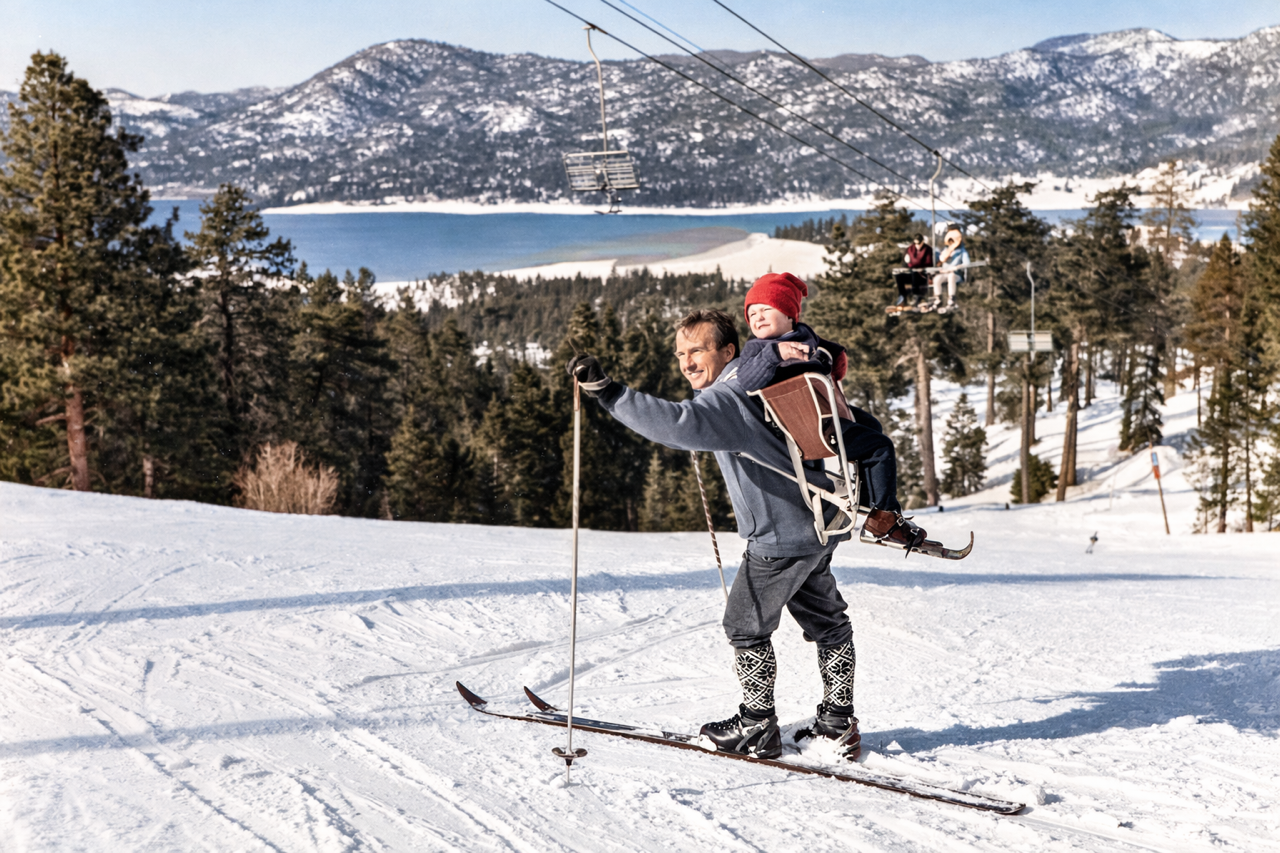
My father and me, late 1960s
My father died twenty years ago. Of the hundreds of things he must have told me during his lifetime, it seems slightly ridiculous that this particular story should have lodged itself so permanently in my brain.
But it did.
I remember quite consciously deciding which of those two boys I wanted to be.
I wanted to be the one looking for the pony.
I don’t mean that I have spent my life believing that everything will always turn out wonderfully. It plainly doesn’t. Bad things happen. Plans collapse. Machines stop working precisely when twelve people are watching. People disappoint you. Sometimes there really isn’t a pony.
But I seem to have decided very early that when something went wrong, I would rather start looking for what could be done than devote too much time to what couldn’t.
It became such an automatic response that I eventually stopped noticing it.
Over the years, however, other people have.
People I have worked with have occasionally said that one of the things they remember about working with me is that I remain optimistic and calm in the most potentially stressful or challenging situations.
Considering that much of my working life has been spent in recording studios, where enormously complicated collections of electronics are required to behave impeccably in the presence of musicians, deadlines and money, this has been tested fairly thoroughly.
Whenever someone says it, I am quietly pleased.
Because I suspect I know where at least some of it came from.
A little story my father told me when I was a boy.
Recently I began wondering where he had got it.
Had he invented it?
Apparently not.
The story goes back remarkably far. The earliest printed ancestor I could find dates from 1902, and over the following decades it gradually acquired the ingredients I remember.
By 1953, there was a version containing two contrasting children, a room full of toys, another filled with manure, a shovel and an optimist convinced that somewhere in all of it there simply had to be a pony.
My father was born in 1939, so the story had been circulating throughout his childhood.
Perhaps his father told it to him. Perhaps he heard it at school, from a friend or somewhere else entirely. I will never know.
I rather like the possibility that it simply travelled. From one person to another, through different families and different generations, until sometime in the late 1960s it reached a small boy sitting with his father.
Me.
But while looking into all this, I discovered something else.
I had remembered the story wrongly.
For years, the version in my head had been slightly different.
In my version, there were still two little boys and two rooms.
But both rooms were full of horse manure.
At the end of the experiment, the psychologist opened the first door and found one boy sitting in the corner crying.
Then he opened the second.
That boy had spent the entire day digging tunnels through the manure.
“What on earth are you doing?” the psychologist asked.
And the boy replied:
“With all this manure, there must be a pony in here somewhere.”
Somewhere during the intervening sixty years, my memory had quietly edited the story.
And, rather neatly, I think I prefer my version.
Because my memory had removed the toys.
It had removed the advantage enjoyed by one child and the disadvantage imposed on the other.
It had removed luck.
Both boys had been given exactly the same room.
The only difference was what they decided to do once they found themselves in it.
I seem to have unconsciously rewritten my father’s little parable into the lesson I had actually taken from it.
You don’t always get to choose the room.
But you do get some choice about what you do when the door closes behind you.
And apparently, somewhere in my childhood, I decided which boy I was going to be.
Sixty years later, I’m still digging.
